
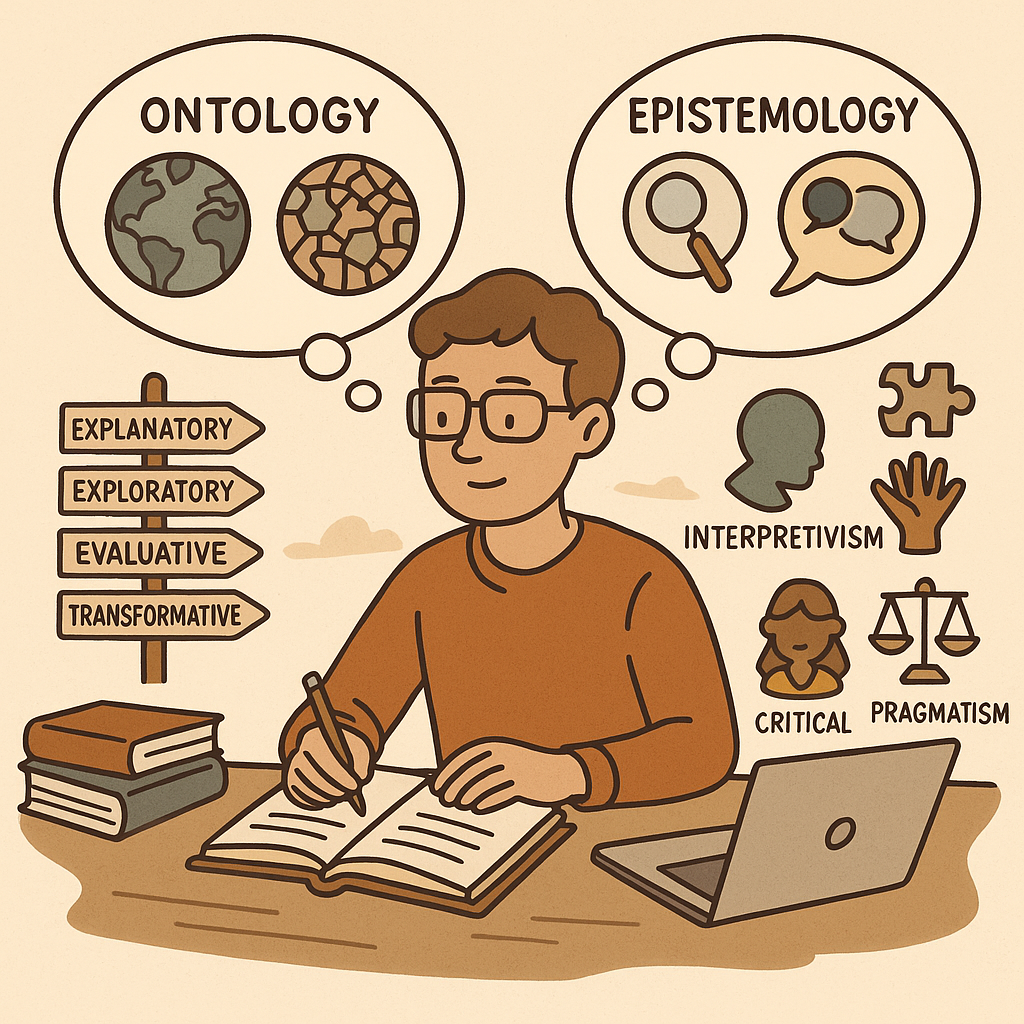
For practitioner-scholars in health and social care, research is not a detached academic exercise. It is a purposeful, practice-based inquiry that seeks to generate knowledge grounded in real-world complexity. One of the most important aspects of this journey is making methodological decisions that are not only technically sound but philosophically coherent. This means aligning methodology with the research purpose and making those decisions transparently and robustly.
At the heart of these decisions lie two foundational concepts: ontology and epistemology. These are not abstract academic terms. They are essential tools for thinking critically about how we design research and how we justify our choices.
Ontology and epistemology: foundations for inquiry
Ontology refers to our beliefs about the nature of reality. In research, this means asking: what is the phenomenon I am investigating, and how does it exist in the world? For practitioner-scholars, this question is often shaped by professional experience. For example, is patient safety a fixed, measurable outcome, or is it a dynamic, relational process shaped by context and interpretation?
If you believe that reality exists independently of human perception and can be objectively measured, you are working from a realist ontology. This view supports structured, quantitative methods. If you believe that reality is constructed through social interaction and shaped by individual and collective meaning-making, you are working from a relativist ontology. This view supports qualitative, interpretive approaches.
Epistemology concerns how we know what we know. It asks: what counts as valid knowledge in this context? For practitioner-scholars, this often involves balancing formal evidence with experiential insight. A positivist epistemology values empirical observation and generalisable findings. An interpretivist epistemology values understanding, context, and the co-construction of meaning.
These ontological and epistemological positions are not just theoretical. They shape the entire research process. They influence the kinds of questions we ask, the methods we choose, and how we interpret our findings. Crucially, they must be aligned with the purpose of the research.
Methodological alignment: purpose-driven design
Rather than choosing a paradigm first and fitting the research into it, practitioner-scholars are tend to begin with the research purpose. What is the inquiry aiming to achieve? Is it explanatory, exploratory, evaluative, or transformative? Once the purpose is clear, the researcher can reflect on their ontological and epistemological assumptions and select a methodology that aligns with both. This alignment ensures that the research design is coherent, ethically sound, and capable of generating meaningful insights.
For example, a study evaluating the effectiveness of a new intervention may adopt a post-positivist stance, using structured surveys or trials to measure outcomes. A study exploring the lived experience of care workers may adopt an interpretivist stance, using interviews to understand meaning and context. A study aiming to challenge systemic inequalities may adopt a critical stance, using participatory methods to empower participants and advocate for change. A study addressing a complex, multi-layered issue may adopt a pragmatic stance, using mixed methods to integrate different forms of knowledge. Each of these approaches is valid, but only when the methodology is clearly aligned with the research purpose and the philosophical assumptions underpinning it.
Paradigms in brief: supporting methodological choice
Research paradigms offer structured ways of thinking about ontology and epistemology. They provide a philosophical framework that guides methodological decision-making.
- Post-positivism assumes that reality exists independently of human perception but acknowledges that our understanding of it is always partial and influenced by theory. It supports quantitative methodologies and deductive reasoning, making it suitable for research that seeks to measure outcomes or test hypotheses.
- Interpretivism holds that reality is socially constructed and that knowledge is subjective, contextual, and co-created. It supports qualitative methodologies and inductive reasoning, making it ideal for research that seeks to understand lived experience or explore meaning.
- The critical paradigm views reality as shaped by power structures and social inequalities. Knowledge is political and should be used to challenge oppression and promote justice. It supports participatory and action-oriented methodologies, making it appropriate for research that aims to empower marginalised groups or advocate for change.
- Pragmatism rejects rigid adherence to any single paradigm. It prioritises the research question and supports the use of mixed methods when appropriate. It is particularly useful where problems are complex and multifaceted.
Transparent and robust decision-making
In professional doctorate research, transparency is key. Practitioner-scholars must be able to explain and justify their methodological choices, not only to examiners and supervisors, but to themselves, their practice-base colleagues and their participants.
Robust decision-making involves:
- Articulating the research purpose clearly and concisely.
- Identifying ontological and epistemological assumptions and reflecting on how they shape the inquiry.
- Selecting methods that are appropriate, ethical, and feasible in the practice context.
- Justifying choices in relation to the research question, the paradigm, and the intended contribution to practice and academia.
- Reflecting on positionality, including how professional identity and experience influence the research.
This process strengthens the credibility of the research and supports ethical, reflexive research practice. It also helps practitioner-scholars navigate the complexity of real-world inquiry, where methodological decisions are rarely straightforward.
Ontology and epistemology in practice-based research
For practitioner-scholars, ontology and epistemology are not abstract philosophical concerns. They are embedded in everyday professional reasoning. When a nurse reflects on the meaning of compassionate care, or a social worker considers how context shapes decision-making, they are engaging with ontological and epistemological questions.
Bringing these reflections into the research process allows practitioner-scholars to design studies that are grounded in their professional realities. It also supports the development of methodologies that are responsive to the complexity, uncertainty, and relational nature of health and social care practice.
By making these philosophical foundations explicit, practitioner-scholars can ensure that their research is not only methodologically sound but also ethically robust and practically impactful.
Conclusion: philosophy in practice
Ontology and epistemology are not just academic concepts. They are practical tools for designing meaningful research. For practitioner-scholars in health and social care, engaging with these foundations enables more thoughtful, transparent, and robust methodological decision-making. By aligning methodology with research purpose and making philosophical assumptions explicit, practitioner-scholars can produce research that is not only academically rigorous but also deeply relevant to practice. This alignment is the cornerstone of credible, impactful professional doctorate inquiry.
Leave a Reply