
by Dr Maxine Wallis-Redworth
Introduction
You may well be scratching your head and thinking ‘Why do Professional Doctorate Programmes need a Wellbeing Lead? I thought these students are adults?’
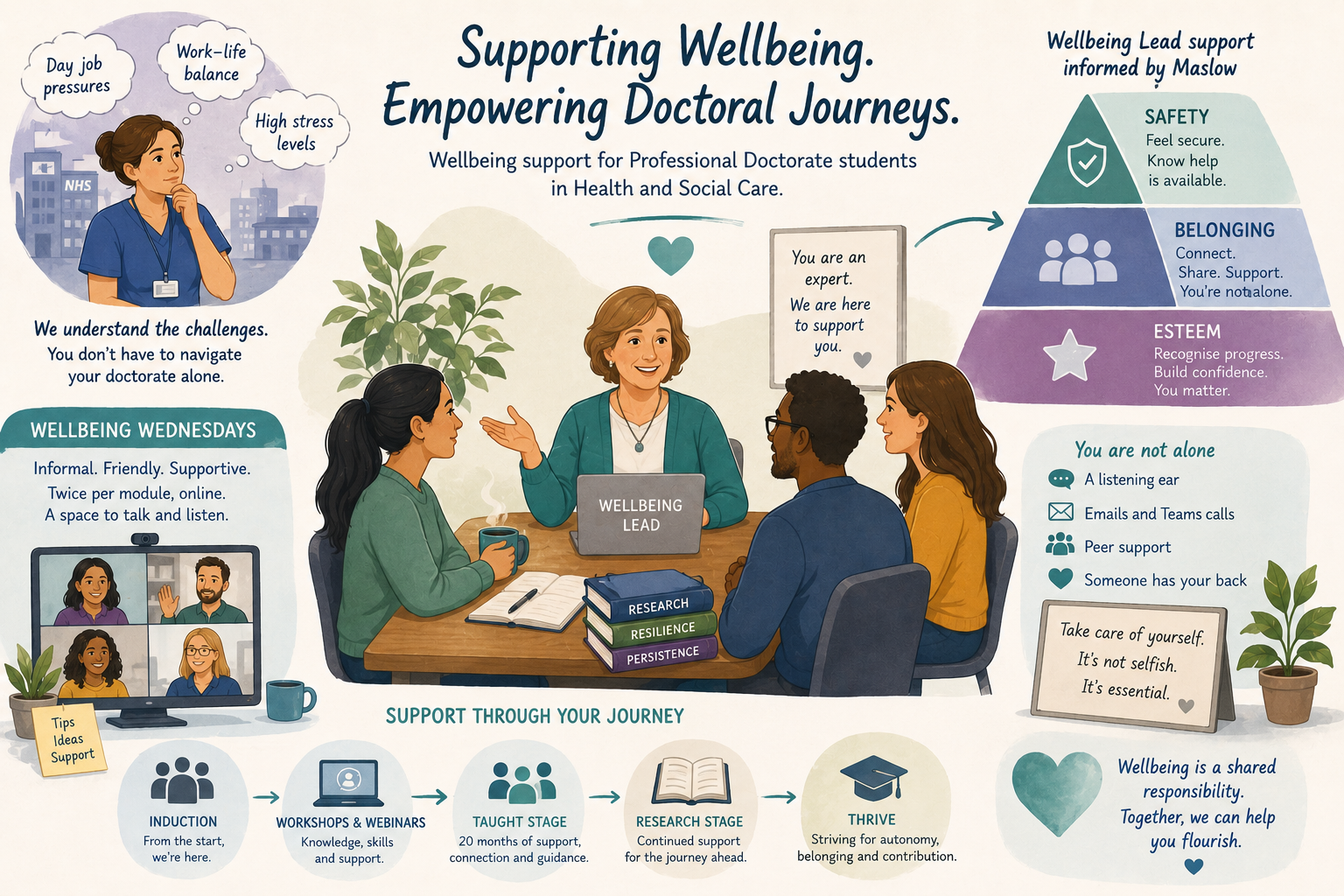
You may be right in making such an assumption, but the demands of undertaking a Professional Doctorate in Health and Social Care within the UK cannot be ignored or underestimated, given the challenges that the health and social care world faces. Those coming to undertake a Professional Doctorate in Health and Social Care are already well-established professionals working in the NHS and Social Care systems. There is recognition that these systems in the UK are ‘broken’ (Streeting, 2024) with employee stress high (Mallorie, 2024). A Kings Fund report (West, Bailey and Williams, 2020) identified that to ensure wellbeing, people had core needs of autonomy, belonging and contribution. In this blog I discuss how such doctoral students are supported in one university.
The role of wellbeing lead
Within my university the programme is offered on a part-time basis, mindful of the type of applicant and the need to stay close to the ‘day job’ to undertake the research. These doctoral students are experts in their field but frequently feel like imposters in the world of academia, readily admitting to feeling out of their comfort zone. Additionally, they are bringing with them the issues of the day job as alluded to above.
In shaping the role of Wellbeing Lead, I drew on decades of course leader and personal tutor role experience with midwifery students. I have taken the principle of focusing on the individual person and used parts of Maslow’s hierarchy of needs (1943) to frame how support is offered. This role sits alongside and complements that of learning partner (akin to a personal tutor) in the taught stage and the supervisors 9n the research stage of their doctoral programme, focusing on personal wellbeing rather than academic achievement and progression. As a Wellbeing Lead I find that the elements of Safety, Belonging, and Esteem from Maslow’s hierarchy of needs align with the needs of the doctoral students.
Wellbeing support
Wellbeing support is an inherent thread that starts on the induction day and carries on specifically through the Taught Stage over the next 20 months and more widely into the research stage. Support means I am visible and participate in all online workshops and webinars and lead on the twice per module Wellbeing Wednesday sessions. These sessions are run informally online for an hour in the early evening – this is mindful of the demanding and inflexible nature of many of the ‘day job’ roles undertaken by these doctoral students and competing family life.
These sessions are an opportunity to chat about anything and everything related to doctoral study. I started the role thinking I would need to provide a structured programme of events but jettisoned that rapidly when all that was needed was a space to chat and all I was required to do was listen and offer suggestions occasionally. The sessions rapidly turned into a facilitated space where peers could support each other and pass on ‘tips and tricks’ in relation to their doctoral modules. In relation to Maslow’s hierarchy of needs the sessions facilitate meeting safety, belonging and esteem.
Safety:
The role facilitates a sense of security and ensuring students remember the signposting to various resources to aid their academic studies and their personal wellbeing. Research is recognised as being a ’messy’ activity that is not totally predictable. It is also important to remind them that safeguarding their health and wellbeing is not selfish but essential part of their doctoral journey.
Belonging:
Having one intake each academic year fosters a sense of belonging. As a team we emphasise community. The informality of Wellbeing Wednesdays offers another forum of online community and connection through a shared journey and understanding. The sessions help forge more meaningful relationships that are mutually respectful. A strong element is the peer support these sessions provide with advice, tips and tricks offered student to student.
Esteem:
It is important to respect the feelings, hopes and fears that doctoral students bring with them. Wellbeing supports facilitates the promotion of confidence, recognition of all achievements (small and large), and that it is alright to be a unique individual who is moving forward in a different way to their peers.
Outside of Wellbeing Wednesday sessions support comes through emails and Teams calls. Some of you might be wondering if the doctoral students rely on this service rather than taking personal responsibility. My experience is no – they use the role as a sounding board rather than as a lifeline or crutch.
No matter how good you are at your job, it is always nice to know that someone has your back – human beings need compassion as they navigate a new chapter of their lives.
Last thoughts
The informal feedback from the doctoral students is that they find the availability of Wellbeing sessions supportive and reassuring. Doctoral study wellbeing is multifaceted and their needs require multiple forms of support. The more structured delivery of workshops and webinars cannot fulfil all needs. Utilising a more informal and responsive strategy is helping to facilitate overall wellbeing in doctoral students ensuring that they can strive for autonomy, belonging and contribution.
References
Mallorie, S. (2024) Beneath the surface: what does the 2023 NHS Staff Survey really tell us? (Blog). The Kings Fund.
Maslow A.H. (1943) A Theory of human motivation. Psychological Review, 50, 370-396.
Streeting, W. (2024) The NHS is broken: Health and Social Care Secretary statement. https://www.gov.uk/government/speeches/statement-from-the-secretary-of-state-for-health-and-social-careWest, M., Bailey, S and Williams, E. (2020) The courage of compassion – Supporting nurses and midwives to deliver high-quality care. The Kings Fund.