
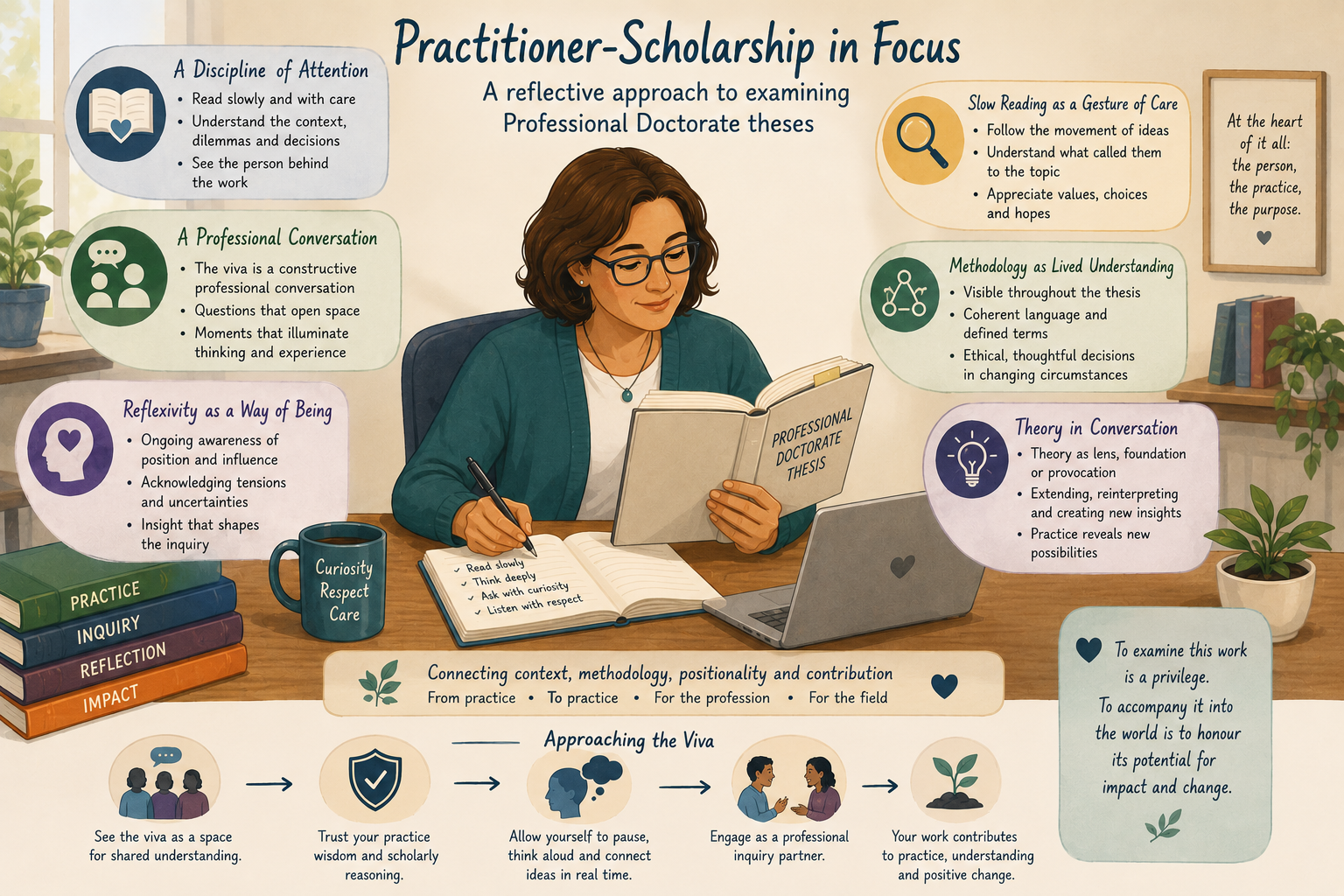
For me, the discipline of attention sits at the heart of practitioner-scholarship. Each time I open a professional doctorate thesis, I do so with respect for the sustained curiosity and care that shape such work. A thesis is never just a collection of pages; it represents committed inquiry carried ethically over time. It reveals lived practice, reflective judgement and a willingness to stay close to real world complexity.
To examine this work is a privilege. The process allows me to witness the depth of a practitioner- scholar’s thinking and to accompany their contribution as it prepares to enter a wider professional landscape.
A professional conversation shaped by attentiveness
I am very aware that many candidates imagine the viva as a trial. In reality, it becomes a constructive professional conversation when everyone approaches it with curiosity, respect and a shared commitment to learning. The viva brings together people who care about practice, about knowledge and about what becomes possible through inquiry.
My questions are never designed to trap or unsettle. Instead, I ask questions that open space, questions that invite candidates to unfold their reasoning or bring forward ideas that sit quietly between the lines. Some of the most illuminating moments appear when practitioner-scholars speak from the depth of their lived experience and recognise that what they know matters.
Approaching the viva
- See the viva as a space for shared understanding. So, still a defence, but one centred on justifying your reasoning in response to questioning rather than resisting critique.
- Trust that your practice wisdom and scholarly reasoning belong together.
- Allow yourself to pause, think aloud and connect ideas in real time.
Slow reading as a gesture of care
My own discipline of attention begins long before the viva. I read slowly, following the movement of ideas and lingering with emerging questions. By the time we meet, I have lived with the thesis long enough to form an impression of the context, dilemmas and decisions that shape it.
Practitioner-scholarship is guided as much by experience as by theory. Curiosity about the person behind the work informs my reading. I want to understand what called them to the topic, how their values shaped their choices and what they hope their inquiry will enable.
Questions that guide my reading
- What practice issue created urgency or opportunity?
- Why does this issue matter to the practitioner, organisation or community?
- How did professional experience shape methodological and ethical decisions?
- What contribution does the work offer to practice or understanding?
- How does the thesis invite a fresh view of a familiar issue?
This curiosity is relational. It recognises that a thesis expresses lived engagement as much as it reports research.
Methodology as applied, lived understanding
Strong practitioner-scholarship presents methodology as a living presence. It appears not only in a dedicated chapter but in design choices, relationships with participants, analytic reasoning and the overall tone of the writing. Methodology becomes the quiet architecture of the inquiry.
Clarity reassures me. Defined terms, coherent language and alignment with a chosen orientation signal that the candidate knows the intellectual home from which they work. Professional doctorate candidates often navigate shifting circumstances, and rigour emerges when methodological principles guide decisions throughout those changes.
Demonstrating methodological strength
- Show how methodological principles guided decisions in the field.
- Use language that reflects your methodological orientation.
- Define key terms and use them consistently.
- Describe how you responded ethically and thoughtfully to unexpected circumstances.
- Ensure your account of what you did aligns with what you actually did.
The relationship between theory and your own thinking
I pay close attention to the way candidates work with theory. Theory can serve as a lens, a provocation, a foundation or a conversational partner. What is important is the quality of the relationship between established ideas and practitioner insight.
Some theses extend theoretical traditions. Others reinterpret concepts through lived practice. Both contribute meaningfully when managed with care.
Questions I often hold
- How has theory illuminated the practice context?
- Where does the candidate extend or reinterpret established thinking?
- How does practice based insight reveal new possibilities or tensions within the theory?
This relational engagement with theory is one of the most distinctive qualities of practitioner- scholarship.
Reflexivity as a way of being
In practitioner-scholarship, reflexivity is not an add on. It is a posture, an ongoing attentiveness to one’s position, influence and ethical responsibilities. I look for reflexivity that threads through the entire thesis, especially where candidates recognise how their identity shapes decisions, interpretations and relationships.
Strengthening Reflexivity
- Acknowledge tensions, uncertainties and moments of discomfort.
- Show how professional identity influenced your judgments and choices.
- Describe how reflexive insight redirected or refined your inquiry.
Connecting context, methodology, positionality and contribution
A coherent thesis weaves together context, methodology, practitioner identity and contribution. These elements support one another. When held together attentively, they produce scholarship that feels grounded, authentic and meaningful.
Practitioner-scholars often work across multiple domains:
- their own practice
- their organisation or system
- their wider professional community
- the academic field
A strong thesis traces how an inquiry grows from practice, speaks back to practice and contributes knowledge that resonates across these interconnected spaces.
The thesis as a sign of care
A well‑crafted thesis shows attentiveness through its structure, clarity and flow, helping the reader follow the argument with ease. As an examiner, I value being guided thoughtfully through the work, with each paragraph, section and chapter supporting the central focus. I also notice the care given to me as the reader, the small signs that you have anticipated my questions and shifted from deepening your own understanding to supporting mine.
Supporting structure and flow
- Give each chapter a clear purpose.
- Build steadily toward your central argument.
- Guide the reader by showing how each part belongs to the whole.
- Check grammatical accuracy and follow referencing conventions diligently.
Conclusion: sustaining the discipline of attention
Examination is a collaborative, respectful process that invites honesty, curiosity and depth. My role as an examiner is to strengthen the work while honouring the courage, labour and insight that practitioner-scholars bring to their inquiry.
A thriving professional doctorate journey grows from research that is thoughtful, applied, reflexive and ethically grounded. The discipline of attention that shapes each stage of the research journey continues into the viva and then moves outward into practice and scholarship beyond the award.
Engaging in practitioner-scholarship signals a commitment to learning, meaningful contribution and thoughtful action. Each thesis becomes part of a wider community of inquiry, and each candidate carries forward insight that can shape practice, influence systems and open new possibilities.
A professional doctorate represents far more than a qualification. It reflects a way of engaging with the world through sustained attentiveness, curiosity and care.
A gentle pause for attention
As you continue your own research journey, you may find it helpful to pause and reconnect with what grounds and guides your work.
- Consider taking a moment to reflect on what first called you to your inquiry, how your practice wisdom and scholarly reasoning speak to one another, and how your writing can support the reader as much as it supports your own understanding.
- Notice where your methodological commitments show up in real decisions, and how your identity and experience shape the choices you make.
These gentle pauses can help you stay attentive, thoughtful and connected to the deeper purpose of your practitioner‑scholarship.