
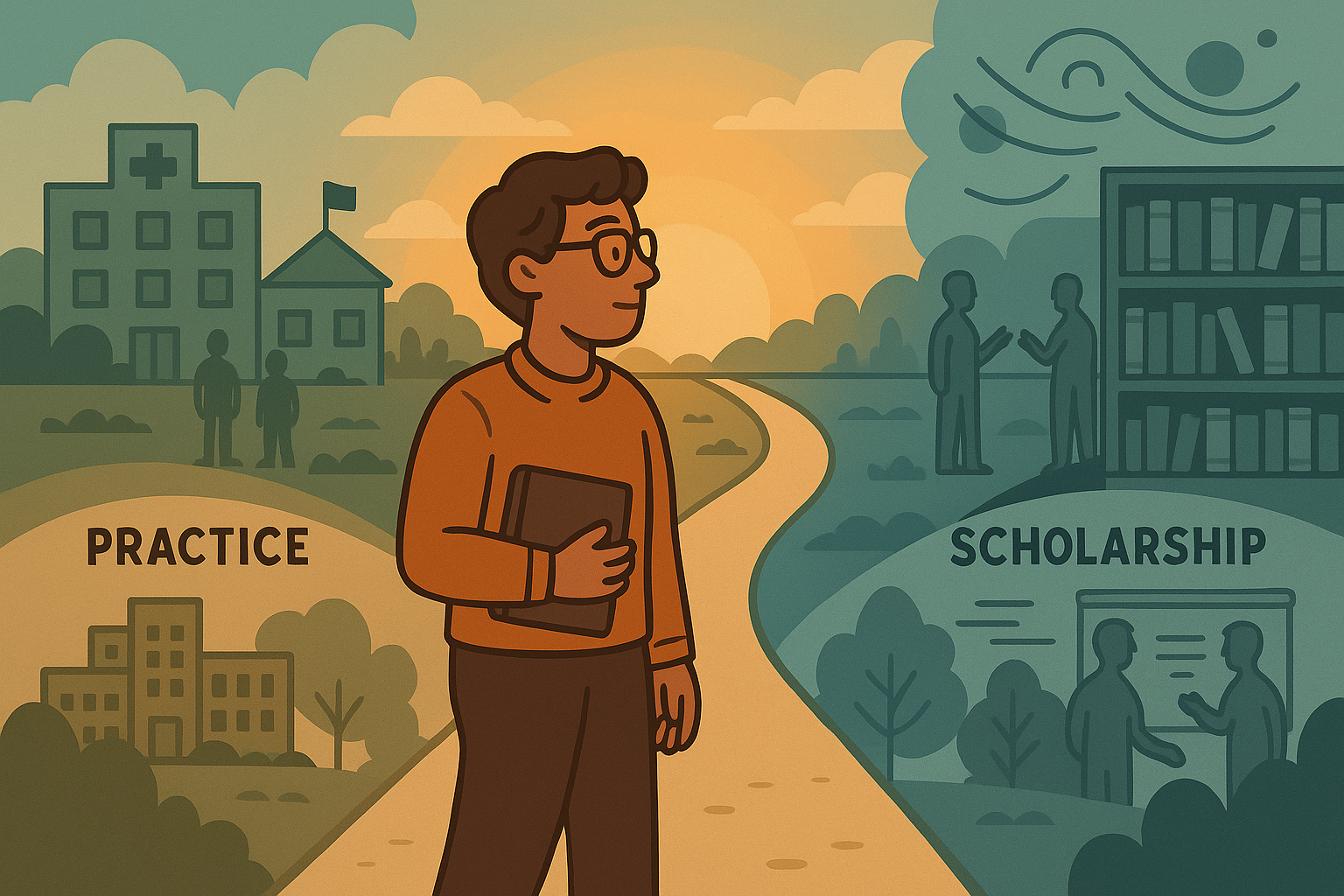
Beginning a professional doctorate in health or social care often feels like stepping into two worlds at once. On one side lies the familiar territory of practice, with its routines, values, and ethical demands. On the other sits the more abstract terrain of scholarly inquiry, where assumptions are examined, concepts debated, and meaning constructed. The challenge for many practitioner-scholars is learning to live productively at this intersection, navigating between practice and academia while maintaining integrity in both.
This blog explores that journey through the lens of Gadamer’s philosophical hermeneutics, particularly his concept of horizons, the idea that understanding develops when our perspectives encounter others and shift through dialogue. In professional doctorates, this metaphor captures the heart of transformation: research as a fusion of practice-based knowing and academic reasoning.
Becoming a practitioner-scholar
For those undertaking a professional doctorate, identity work sits at the centre of the experience. Candidates are not simply practitioners doing research, nor academics applying theory, they are practitioner-scholars, moving between two knowledge traditions. Each world has its own horizon: professional knowledge shaped by lived experience, and academic knowledge structured by theory and rigour. The learning journey involves navigating between them until they begin to overlap and inform one another.
This is rarely comfortable. There are moments when practice feels questioned by theory, or when academic critique seems to distance practitioners from the professional communities they know so well. Yet, as Gadamer reminds us, understanding deepens precisely through such encounters. The fusion of horizons does not erase difference; it generates new ways of seeing. For practitioner-scholars, this fusion often takes the form of becoming more reflexive, more attuned to ethical complexity, and more confident in articulating their professional wisdom as evidence-informed knowledge.
Working through uncertainty
Professional doctorates are frequently part-time, taken alongside demanding roles and personal commitments. This makes study fragmented, reflective writing interrupted, and thinking constantly negotiated with the pressures of real-world practice. But these very conditions invite a deeper level of reflexivity. Working through uncertainty, intellectual, emotional, and practical, can become a powerful form of growth.
Moments of disorientation, when the familiar becomes strange, are often where insight begins. As Wadham and Parkin observe, such “strange moments” invite practitioner-scholars to question what once seemed obvious and to see their professional worlds anew. Rather than resisting this discomfort, candidates can treat it as a sign that their horizons are expanding.
Reflexivity and situated understanding
In practice-based research, reflexivity is not a methodological afterthought but the means through which credibility and ethics are maintained. Practitioner-scholars bring with them values, histories, and commitments that inevitably shape how they interpret what they study. Acknowledging these influences through structured reflection, supervision dialogue, and transparent writing turns positionality into a strength rather than a source of bias.
Reflexivity, in this sense, is not about self-focus but about relational awareness, seeing how understanding arises through engagement with others, texts, and contexts. It aligns with Gadamer’s view that interpretation is always situated. For professional doctorate scholars, knowledge is co-constructed, arising from the dynamic interplay between lived experience and critical inquiry
Research-mindedness as a transformative practice
Developing a research-minded approach is one of the major transitions practitioner-scholars are likely to experience. This evolution goes beyond acquiring research skills; it involves cultivating curiosity, openness, and ethical sensitivity. In this way, thinking is no longer tethered to definitive answers and instead flows toward possibilities and new horizons of understanding. Engaging in communities of practice, peer discussions, and supervisory dialogues helps sustain this transformation. Through such collaboration, practitioner-scholar learn that research is not just about method but about meaning making by working through complexity rather than simplifying it.
Why this matters
The metaphor of navigating horizons helps to make sense of the professional doctorate as more than an academic qualification. It is a transformative venture, one that redefines how practitioners see their work and themselves. As practitioner-scholars move through the fusion of professional and academic horizons, they contribute new forms of knowledge that are both rigorous and responsive to real-world needs.
Recognising this process also has implications for how institutions support part-time researchers. Professional doctorate programmes flourish when they acknowledge the emotional labour, identity negotiation, and ethical reflection that accompany scholarly growth. Supervision, peer networks, and institutional structures must work toward enabling the interpretive and dialogic nature of professional learning.
Closing reflection
Undertaking a professional doctorate means continually revising one’s understanding of practice, self, and scholarship. Gadamer’s concept of the fusion of horizons offers a powerful way to think about this journey. It reminds us that research is not about arriving at certainty but about remaining open to transformation.
Professional doctorates in health and social care invite this inquisitiveness in its fullest sense. The process asks practitioners to bring their professional insight to the table, to question it, and to allow it to evolve into scholarship that is both ethically grounded and intellectually alive. Through this, practitioner-scholars do more than earn a doctorate, they reshape the horizons of their professions.
Key takeaways
- Professional doctorate study involves navigating between professional and academic horizons.
- Identity transformation is a core feature of becoming a practitioner-scholar.
- Reflexivity ensures that positionality enhances rather than undermines credibility.
- Research-mindedness grows through dialogue, community, and ethical reflection.
- Gadamer’s fusion of horizons captures the transformative potential of professional doctorates.