
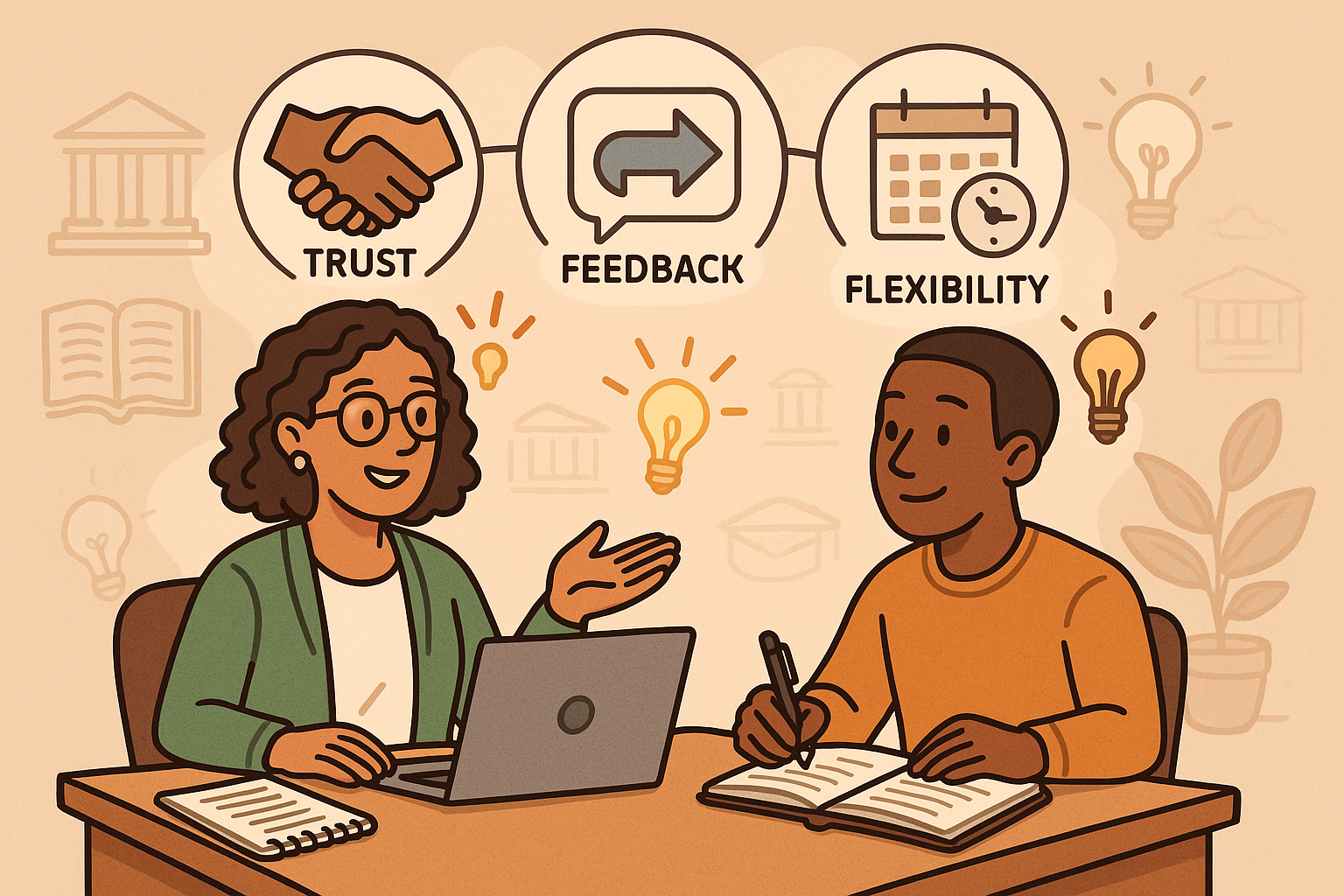
The supervisory relationship is at the heart of the professional doctorate experience. For candidates, it is the space where research ideas are tested, confidence is built, and scholarly identity begins to take shape. For supervisors, it is a delicate balancing act, encouraging timely progress, fostering independence, and supporting the personal and professional lives that run alongside doctoral study. Research confirms what many already know through practice: the quality of supervision significantly shapes how doctoral researchers perceive their journey.
Supervision as partnership
Supervision is rarely a one-way transmission of expertise. Instead, it is a partnership that evolves over time. At first, it often involves supervisors setting the pace by suggesting strategies for time management, shaping agendas for meetings, and providing reassurance that work-in-progress is valuable. As candidates grow in expertise, it shifts. The relationship becomes more reciprocal, with supervisors moving from guiding to challenging, and explicitly recognising when scholarly authority is being transferred.
This shift in balance can be a milestone moment. It signals that a candidate is no longer dependent on their supervisor’s lead, but stepping into autonomy as a researcher. Marking and celebrating this helps both supervisor and candidate to acknowledge progress, and it reinforces confidence in moving forward.
Trust as the cornerstone
Trust is the foundation of an effective supervisory relationship. Without it, feedback may be misunderstood, resisted, or feared. Kay Guccione’s research for AdvanceHE highlights that doctoral candidates often begin with implicit trust in supervisors, yet this trust can quickly erode if feedback is inconsistent, promises are not kept, or communication is unclear. When this happens, it leads to concealment behaviours such as avoiding meetings or hiding unfinished work.
Supervisors, too, experience vulnerability. They work within institutions that expect completions on time, while rarely acknowledging the emotional labour involved in sustaining trust. For both sides, it is trust that creates the conditions where doubts can be shared, feedback can be received openly, and progress can continue despite setbacks.
Feedback, confidence and growth
Feedback is one of the most powerful ways trust is built or broken. When it is framed as “feedforward” – a developmental dialogue about what to try next – it becomes an empowering process rather than a judgement. By contrast, blunt or inconsistent feedback can quickly undermine confidence.
The UKCGE Good Supervisory Practice Framework places feedback at the centre of supervisory responsibility, emphasising that candidates should be encouraged to write regularly and receive constructive, consistent, and confidence-building feedback. For professional doctorate students, many of whom write alongside demanding jobs, this is particularly important. Feedback is not just academic; it is also a form of support for wellbeing.
Supervisors must remain attentive to their communication style. Feedback intended to be efficient can sometimes come across as blunt or discouraging. Taking time to reflect, seeking peer review of comments, or discussing tone openly with candidates helps to maintain a facilitative atmosphere. This makes it possible to preserve academic rigour while protecting wellbeing.
Flexibility and wellbeing
Most professional doctorate candidates are part-time, combining research with professional and family responsibilities. Effective supervision recognises this reality, treating ground rules as living agreements that adapt as circumstances change. When job roles shift or caring responsibilities increase, timelines for submission or analysis may need to be adjusted.
Flexibility does not lower standards. Instead, it ensures that research remains achievable and that candidates feel supported as whole people. The UKCGE framework highlights that supervisors have a role not only in supporting the research project but also in attending to personal and career development. This reflects findings from AdvanceHE, where candidates reported disengaging when they felt unable to disclose pressures outside their studies. Supervisors who create safe spaces for openness help prevent this, making wellbeing an active part of supervisory practice.
Supervision as pedagogy
Both UKCGE and AdvanceHE highlight that supervision should be understood as pedagogy. It is not just about monitoring progress, but about modelling scholarship, nurturing curiosity, and building confidence. It requires intellectual challenge alongside emotional competence, and it calls for supervisors to pay attention to fairness, recognition, and the values of academic life.
Supervision is also a practice that benefits from reflection. The UKCGE framework explicitly places self-reflection and enhancement at the centre of good supervisory practice. AdvanceHE similarly emphasises that supervisors must continually adapt to new student cohorts and new institutional contexts. Just as candidates develop as scholarly professionals, supervision must also be treated as a practice that evolves.
Preparing for the supervisory role
New supervisors often mirror the approaches they experienced during their own doctorates. This can be positive, but it can also perpetuate unhelpful patterns if those experiences were not supportive. Structured opportunities to act as learning partners, working alongside experienced supervisors, offer valuable preparation. This not only supports new colleagues but also helps candidates by providing them with a team-based approach to supervision during the taught stage of the programme.
Embedding this culture of co-learning acknowledges that supervision is itself a practice requiring attention, reflection, and ongoing development. Just like doctoral study, it is not static but dynamic, shaped by the individuals involved and the institutional context.
Closing reflection
Supervising professional doctorate students is more than guiding research to completion. It is about building trust so candidates feel able to share uncertainties, giving feedback that sustains confidence, and exercising flexibility so that research fits alongside complex professional and personal commitments. It is also about recognising supervision as pedagogy, shaped by reflective practice and supported by national frameworks such as the UKCGE Good Supervisory Practice Framework and the insights of AdvanceHE research.
When it is done well, supervision enables candidates not only to complete their theses, but also to become scholarly professionals who bring curiosity, rigour, and confidence back into their practice, organisations, and communities.
Key Takeaways
- Supervision is a partnership that evolves as candidates gain autonomy.
- Trust is fragile but essential, and must be actively maintained.
- Feedback builds confidence when it is framed as developmental dialogue.
- Flexibility recognises the realities of part-time professional doctorates.
- Both UKCGE and AdvanceHE stress that supervision is pedagogy, requiring reflection and care.
- Learning partnerships prepare new supervisors and strengthen supervisory capacity.